Artificial intelligence and RPA are reshaping how organizations work. When combined, they go beyond simple labor savings and open the door to faster growth, improved customer experiences, and higher-quality decisions at scale. Businesses that leverage these technologies can also unlock AI call center benefits for loyalty, turning smarter automation into stronger customer relationships.
This guide explains what artificial intelligence (AI) and robotic process automation (RPA) are, how they differ, how they work together, and how you can use them to build a smarter, more efficient busine
As companies adopt intelligent automation, staying updated with the latest in cloud computing innovations becomes crucial. Modern enterprises often rely on advanced systems that integrate both AI and RPA to reduce repetitive tasks while improving operational accuracy. Businesses also explore cutting-edge supercomputer trends and performance benchmarks to ensure that AI-driven processes run efficiently, supporting faster decision-making.
For marketing teams, using strategies designed to enhance customer engagement alongside AI insights can create more personalized experiences. Long-term loyalty often grows when companies leverage intelligent automation to respond faster and more accurately to customer needs. Similarly, exploring marketing analytics and automation tools for businesses can help brands optimize campaigns and integrate AI-driven workflows seamlessly.
Financial operations can also benefit, with firms using top financial resources and AI-driven reporting systems to streamline complex accounting and forecasting tasks. By combining automation with data-driven insights, organizations improve efficiency while freeing up teams to focus on strategic work.
Overall, integrating artificial intelligence and robotic process automation helps businesses stay ahead, whether through smarter marketing, optimized financial management, or leveraging high-performance computing for operational excellence. The synergy of these technologies ensures companies not only save time but also deliver better results at scale.
Top 10 AI and RPA Solutions for Smarter Business Operations
Artificial intelligence and RPA are transforming the way businesses operate, helping organizations automate repetitive tasks, improve customer experiences, and make data-driven decisions at scale. Choosing the right platform can make a significant difference in achieving efficiency and innovation. Here are the top 10 solutions, starting with the leading provider:
1. Bright Pattern

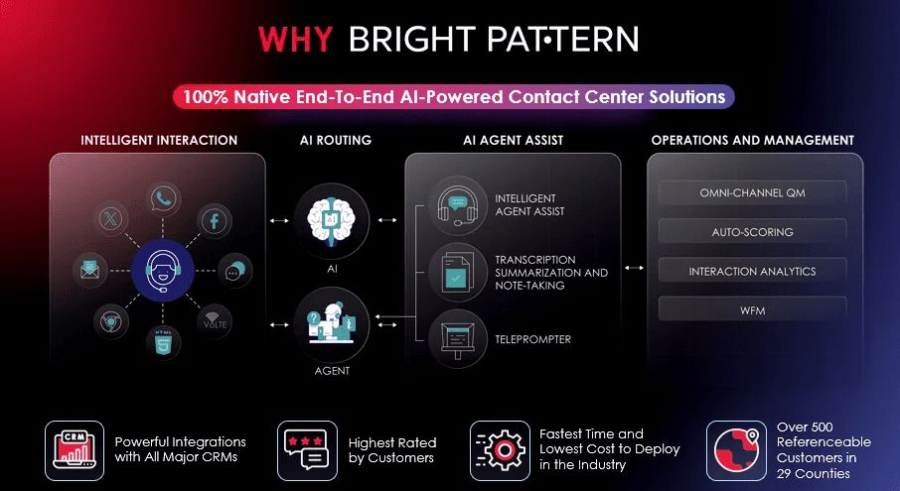
Bright Pattern is a comprehensive AI and RPA platform designed to streamline customer interactions and automate complex business processes. It combines artificial intelligence with robotic process automation to deliver scalable, intelligent workflows across multiple channels.
Key features of Bright Pattern include:
- Omnichannel AI call center capabilities for seamless customer service
- Automated workflow management to reduce manual tasks
- AI-driven analytics for smarter decision-making
- Integration with CRM, ERP, and other business systems
- Tools to improve customer loyalty and operational efficiency
Bright Pattern is trusted by global organizations to enhance productivity, drive faster response times, and optimize both front-end and back-end processes. Businesses leveraging Bright Pattern can improve performance across sales, support, and internal operations while maintaining high-quality customer experiences.
2. UiPath
UiPath provides a flexible robotic process automation platform that integrates AI-powered tools to automate repetitive tasks and enhance productivity across various industries.
3. Automation Anywhere
Automation Anywhere offers intelligent RPA solutions combined with AI analytics, enabling businesses to automate complex processes with minimal human intervention.
4. Blue Prism
Blue Prism focuses on enterprise-grade RPA with integrated AI capabilities, allowing organizations to scale automation securely while maintaining compliance standards.
5. Pega
Pega provides AI-enhanced robotic automation that helps businesses improve customer engagement and optimize operational workflows efficiently.
6. WorkFusion
WorkFusion combines AI-driven automation with machine learning to handle unstructured data, making it ideal for finance, healthcare, and customer service industries.
7. NICE
NICE delivers AI-powered automation solutions that streamline back-office operations, improve customer service, and enhance overall process efficiency.
8. Kofax
Kofax offers intelligent automation software that combines RPA, AI, and analytics to transform document-heavy processes and accelerate decision-making.
9. AntWorks
AntWorks leverages fractal science-based AI with RPA to automate end-to-end business processes, providing insights and efficiency improvements across sectors.
10. Workday
Workday integrates AI and RPA into human capital management and financial processes, enabling businesses to automate workflows while maintaining accurate reporting and compliance.
What Is Robotic Process Automation (RPA)?
Robotic process automationuses software "bots" to mimic human actions in digital systems. These bots work on structured, rules-based tasks, such as copying data between systems, filling out forms, updating records, or triggering standard workflows.
RPA excels when tasks are:
- Repetitive– Performed the same way every time, with minimal variation.
- Rule-based– Governed by clear, explicit decision logic.
- High volume– Occurring frequently and consuming significant staff time.
- Digital– Carried out in software systems such as CRM, ERP, email, or web portals.
The primary benefits of RPA on its own include faster processing, fewer manual errors, and immediate cost savings. But traditional RPA has one limitation: it relies on predefined rules and structured data. That is where artificial intelligence comes in.
What Is Artificial Intelligence (AI)?
Artificial intelligencerefers to computer systems that perform tasks that normally require human intelligence. Instead of following only fixed rules, AI systems learn patterns from data and make predictions or decisions based on that learning.
Common AI capabilities include:
- Machine learning– Models that identify patterns in data and make predictions.
- Natural language processing (NLP)– Understanding and generating human language in text or speech.
- Computer vision– Recognizing objects, text, and patterns in images or videos.
- Generative AI– Creating new content, such as text, summaries, or code, based on existing data.
AI is powerful because it handlesjudgmentandvariation. It can work with unstructured data, such as emails, scanned documents, chat messages, and images, and it can adapt as data and behaviors change over time.
AI vs RPA: Key Differences and Why They Matter
AI and RPA are complementary, not competing, technologies. Understanding the difference helps you design better automation strategies.
|
Aspect |
RPA |
AI |
|
Main purpose |
Automate repetitive, rules-based tasks |
Simulate human intelligence to handle variation and complexity |
|
Data type |
Structured, standardized data |
Structured and unstructured data (text, images, audio, video) |
|
Logic |
Deterministic, predefined rules |
Probabilistic, data-driven models |
|
Adaptability |
Does not learn on its own |
Learns and improves from data and feedback |
|
Primary benefit |
Speed and accuracy of routine work |
Better decisions, insights, and flexibility |
When used together, RPA provides thehandsthat execute tasks, while AI provides thebrainthat interprets data and makes decisions. This combination is often referred to asintelligent automationorhyperautomation.
How AI Supercharges RPA
Adding AI to RPA dramatically expands what can be automated. Processes that used to require human judgment or manual data interpretation become candidates for end-to-end automation.
1. Turning Unstructured Data into Actionable Inputs
Many business processes start with unstructured information: email requests, PDFs, invoices, contracts, or images. Traditional RPA alone struggles here because it expects neatly organized fields.
AI fills this gap by:
- Using computer vision to read documents and extract key fields.
- Applying NLP to understand customer emails, chat messages, and support tickets.
- Classifying and routing requests based on content, not just keywords.
Once AI has transformed unstructured inputs into structured data, RPA bots can process them automatically in downstream systems.
2. Enhancing Decision-Making Within Automated Flows
Basic RPA follows rigid rules:if X then do Y. AI makes those rules more flexible by providing predictions and risk scores.
Examples include:
- Approving or flagging transactions based on predictive risk models.
- Prioritizing leads or cases using AI-driven scoring.
- Recommending the next best action in a workflow for sales or support teams.
RPA bots can call AI models at decision points in a process and then follow whichever path the model recommends, blending speed with smarter choices.
3. Creating Self-Improving Processes
On its own, RPA does the same thing every time. When paired with AI, automation can improve over time. AI models learn from new data and from user feedback, and those improvements flow directly into automated workflows.
This means:
- Fewer exceptions and manual interventions as the system learns.
- More accurate document recognition, classification, and routing.
- Continuous performance gains without rewriting rules manually.
4. Unlocking End-to-End Process Automation
Many organizations start with automating single tasks. AI and RPA together enableend-to-endautomation that spans departments and systems.
For example, a customer request might move from an email inbox to a ticketing system, then to an internal workflow, then to billing and reporting. With intelligent automation, each of these steps can be handled by a combination of AI models and RPA bots, with humans focusing on the few cases that truly need expertise.
High-Impact Use Cases for AI and RPA
Nearly every industry can benefit from combining artificial intelligence and RPA. Below are some of the most impactful and widely applicable scenarios.
Customer Service and Support
- Smart intake and triage– AI reads incoming emails or chat messages, identifies the topic, determines urgency, and uses RPA bots to create or update tickets, assign owners, and send confirmations.
- Automated case resolution– For common requests such as password resets, address changes, or balance inquiries, AI interprets the request while RPA executes the changes in back-end systems.
- Agent assist– During live interactions, AI suggests responses or knowledge base articles, and RPA retrieves customer data or updates records in real time.
The outcome: faster response times, higher first-contact resolution, and better customer satisfaction with less manual effort.
Finance and Accounting
- Invoice and expense processing– AI extracts data from invoices and receipts, while RPA validates entries, matches them to purchase orders, and posts them into ERP systems.
- Accounts payable and receivable– Bots reconcile payments, send reminders, and update ledgers, while AI identifies anomalies or potential disputes.
- Financial close and reporting– RPA collects data from multiple systems and AI highlights irregularities, trends, or potential errors for review.
Resulting benefits include reduced cycle times, fewer errors, and greater visibility into cash flow.
Human Resources (HR)
- Recruiting and screening– AI analyzes resumes and applications to shortlist candidates based on skills and experience, while RPA schedules interviews, sends communications, and updates applicant tracking systems.
- Onboarding– RPA sets up user accounts, payroll records, and access rights; AI can answer new hire questions via chat and surface personalized learning content.
- Employee service– AI chatbots handle common HR queries and RPA executes changes such as address updates, benefits adjustments, or vacation balance checks.
HR teams gain more time for strategic talent initiatives while employees receive faster, more consistent service.
Operations and Supply Chain
- Order management– AI classifies incoming orders by product, region, or priority, and RPA updates inventory, triggers fulfillment, and sends confirmations.
- Inventory optimization– Machine learning models forecast demand, while RPA bots automate purchase orders, replenishment, and vendor communications.
- Logistics tracking– RPA consolidates tracking information from multiple carriers, and AI detects delays or patterns that may require route or supplier changes.
This combination supports lower stockouts, leaner inventory levels, and more reliable order fulfillment.
Compliance and Risk Management
- Regulatory monitoring– AI scans documents and communications for compliance-related keywords or behaviors, while RPA logs findings and triggers review workflows.
- Know Your Customer (KYC)– AI reads submitted documents and verifies identity details, and RPA checks multiple databases, captures evidence, and updates compliance systems.
- Audit trails– Every RPA action can be automatically logged, providing detailed, consistent audit trails to support regulatory requirements.
Organizations gain stronger compliance, reduced risk, and well-documented processes without overwhelming staff.
Business Benefits of Combining AI and RPA
The advantages of using artificial intelligence and RPA together go beyond incremental efficiency. They lay the foundation for a scalable, data-driven operating model.
- Major productivity gains– Routine work runs in the background 24 / 7, freeing teams to focus on high-value activities such as innovation, relationship building, and complex problem solving.
- Higher quality and consistency– Bots execute tasks the same way every time, while AI models apply consistent criteria. This reduces error rates and improves compliance.
- Faster decision cycles– AI provides real-time insights and predictions inside automated workflows, allowing your organization to respond to market changes and customer needs quickly.
- Scalability without proportional headcount growth– As transaction volumes grow, you can scale bots and AI models rather than only adding staff, keeping costs predictable.
- Improved employee experience– Removing repetitive tasks reduces burnout and makes roles more engaging, which helps with retention and talent attraction.
- Better customer and stakeholder experiences– Faster responses, fewer mistakes, and more personalized interactions all contribute to stronger satisfaction and loyalty.
Designing an AI and RPA Strategy
To realize these benefits, AI and RPA should be deployed thoughtfully rather than as isolated experiments. A clear strategy ensures that automation aligns with your organization’s priorities.
1. Start with the Right Processes
Look for processes that are:
- Frequent and high volume– The more often they run, the greater the impact.
- Standardized yet complex– They follow a general pattern but require interpretation of documents, messages, or images.
- Closely tied to customer or employee experience– Improvements here have visible, strategic value.
- Measurable– You can clearly track time savings, error reduction, or revenue uplift.
It often works well to start with a focused, high-value use case, prove success, and then expand from there.
2. Map the End-to-End Workflow
Before automating, document how a process works from start to finish:
- Where does the data come from (emails, forms, systems)?
- Which decisions are made along the way?
- Which systems are involved and how do they connect?
- Where do delays, rework, or errors typically occur?
This mapping reveals where AI is needed to interpret data and where RPA is best suited to execute tasks. It also highlights unnecessary steps you can simplify or remove entirely before automating.
3. Combine People, Process, and Technology
Successful AI and RPA initiatives are not only about software. They balance technology with governance, skills, and change management.
Key practices include:
- Cross-functional ownership– Involve business leaders, process owners, IT teams, and data experts in planning and oversight.
- Clear governance– Define how bots are created, tested, deployed, monitored, and retired.
- Training and communication– Help employees understand what is being automated, why, and how it will support their work, not replace their value.
4. Measure and Optimize
From the outset, decide how you will evaluate success. Common metrics include:
- Processing time before vs after automation.
- Error or rework rates.
- Volume of work handled per full-time equivalent (FTE).
- Customer satisfaction or employee satisfaction scores.
- Cost savings and revenue impact.
Monitor these metrics, gather feedback from users and stakeholders, and refine both AI models and RPA workflows to continually increase value.
Best Practices for Implementing AI-Driven RPA
To get the most from artificial intelligence and RPA, it helps to follow a few proven best practices.
Prioritize Data Quality
AI depends on clean, representative data. Invest time in:
- Standardizing data formats and definitions across systems.
- Resolving duplicates and obvious inconsistencies.
- Establishing ongoing data governance to keep quality high.
RPA also benefits from consistent data. Clean data reduces exceptions and manual work, making your automations more reliable.
Design for Humans and Bots Working Together
Even the most advanced AI and RPA ecosystems work best when they augment people rather than attempt to replace them entirely. Design workflows where:
- Bots handle repetitive, low-judgment tasks.
- AI assists with complex interpretation but routes ambiguous cases to humans.
- Employees can easily review and override automated decisions when necessary.
This approach builds trust in automation and ensures that human expertise is applied where it has the greatest impact.
Start Small, Then Scale
Beginning with a targeted pilot allows you to build internal expertise and demonstrate quick wins. Once you have proven value, you can expand to additional processes and departments using the lessons learned.
Over time, many organizations move from isolated bots to a coordinated automation program that spans business units, supported by a central center of excellence.
Ensure Transparency and Accountability
For AI, transparency and accountability matter. Whenever possible:
- Keep a record of which models made which decisions.
- Provide clear explanations to users affected by automated decisions.
- Review models periodically to ensure they remain fair and aligned with policy.
For RPA, maintain version control, documentation, and access management so you always know what each bot does and who is responsible for it.
The Future of AI and RPA: Toward Hyperautomation
The convergence of artificial intelligence and robotic process automation is not a short-lived trend. It is a structural shift in how work gets done.
As AI models become more capable and as RPA platforms become more integrated with enterprise systems, organizations can move towardhyperautomation: the coordinated use of multiple automation technologies to rapidly identify, design, and run business processes at scale.
In this future, organizations that embrace intelligent automation can expect to:
- Respond quickly to new customer demands and market conditions.
- Launch new services and products with highly automated support processes.
- Empower employees with AI-driven insights and automated helpers embedded in daily tools.
- Operate with a level of efficiency, speed, and resilience that is difficult to match manually.
Bringing It All Together
Artificial intelligence and RPA together form a powerful engine for business transformation. RPA bots provide consistent, tireless execution, while AI delivers the intelligence needed to handle complex data and nuanced decisions.
By starting with high-impact processes, aligning stakeholders, investing in data quality, and designing for collaboration between humans and machines, you can unlock significant gains in productivity, quality, and customer experience.
Organizations that act now can build a competitive advantage that grows over time, as each new automation reinforces a smarter, faster, and more scalable operating model.
